Posts tonen met het label rietganzen. Alle posts tonen

donderdag 9 februari 2012

Bean Geese (7) - there they are, finally

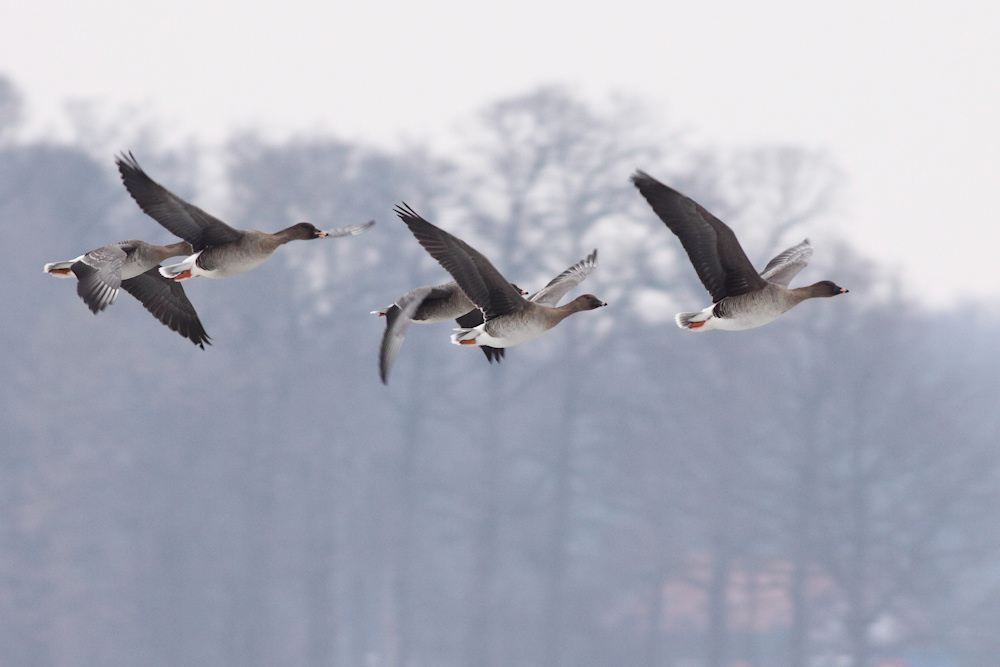
Yesterday, Lützen Portengen found minimal 35 Taiga Beans in a flock of Tundra Beans near Udenhout, Brabant. This afternoon, I observed the group for more than two hours. Here some pics on which I will comment later.

Warning: these pictures also include several Tundra's, two orange-billed 1w Greater Whitefronted and other stuff! Have a look...

Two juvenile albifrons with orange bills. Are they F1 hybrids of a pair of rossicus x albifrons? I couldn't find their parents.
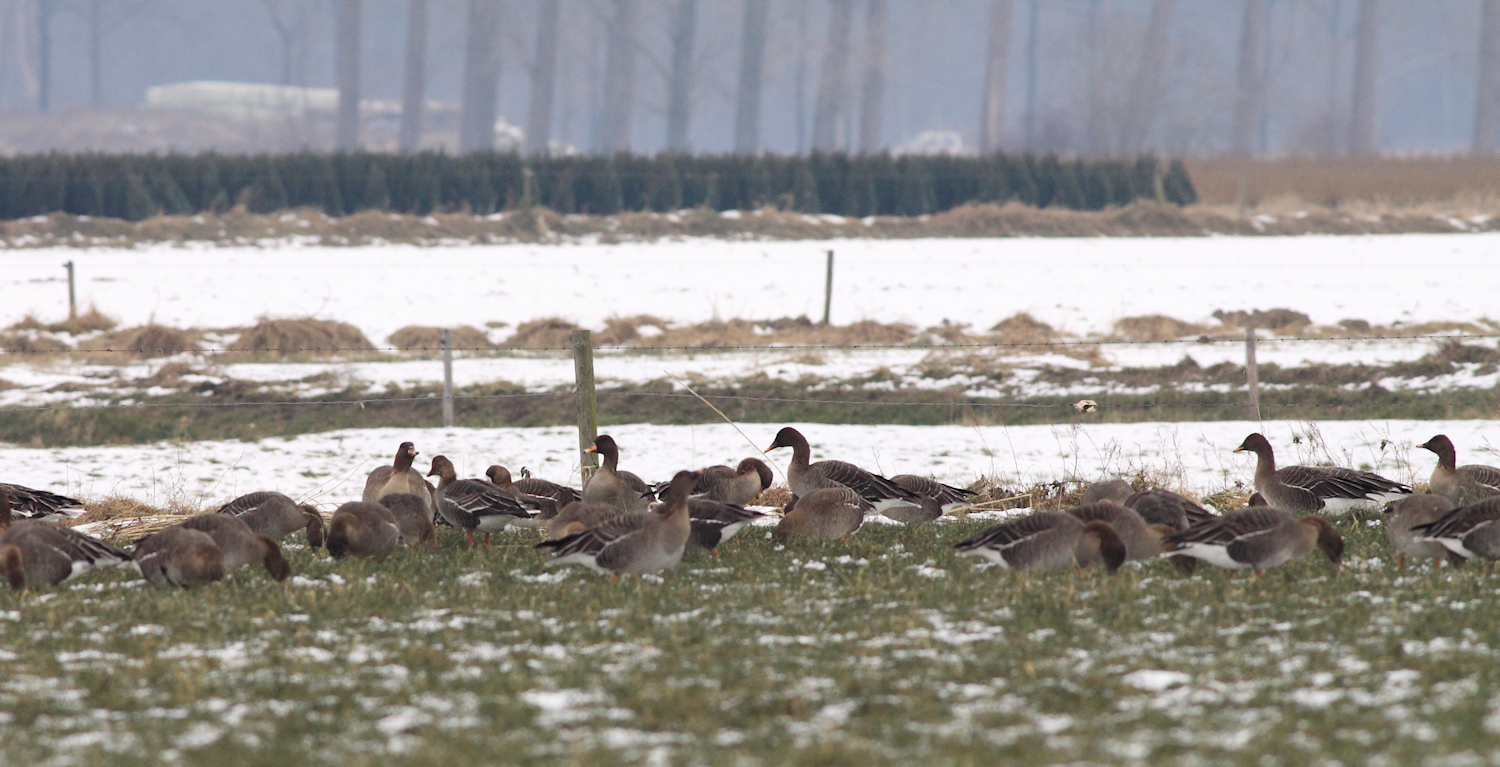
All Taiga Bean fabalis foraging in line, as they did the whole time at the edge of the big flock of rossicus.
Mix of rossicus and fabalis. 12 of the latter. Note the more slender structure and bowed necks of the birds from the Taiga!

Another part of the line of fabalis also mixed with most rossicus. The Taiga birds didn't move a lot.
Some just landed albifrons and rossicus in front of the massive group.
Some rossicus with two orange bills. Don't think it are fabalis. I followed these birds after landing and concluded that it were two males with type B bills!
Neckband from Germany.
Two fabalis, just one visible at left.
Alert at the background! Part of the line.
Alert male with a type A bill. Some more fabalis around, but not visible.
Interestingly, the little yellow-billed bird at the left was paired with a straight fabalis. That must be a female! The birds in the centre are more straight forward.
rossicus: 1w, ad male type B, ad, ad, ad
The same group.

Can you do it by yourself?


zaterdag 7 januari 2012

Bean Geese (4) - Misleading pictures...

Yesterday, a Taiga Bean Goose was reported right in an area where Taiga's winter sometimes. The pictures are showing an alert, quite yellow and slenderbilled Bean. The base of the upper mandible is not so high and the lower mandible looks straight from the base to the tip. Also, the slender and rather long neck looks good for fabalis, as the deep brownish colouration of the head, slightly converging into the greyish neck. So far, reasons enough to visit this bird.

This morning, the bird was still present and found by PieterGeert Gelderblom. We observed the bird for some minutes, carefully judging the billshape. In the field, the height of the grinning patch (or curve of the lower mandible) turned out to be better for rossicus. Although the base of the upper mandible wasn't high, the bill looked to stubbish for a fabalis due to the length. The colouration of the head didn't differ from the other 9 birds. The size of the bird did fit a big rossicus or small fabalis, but the structure didn't differ from the others. The group contained typical rossicus birds with type C and D bills. Did we forget the rule: Bean Geese could be best identified by group? I think we were hoping for just one fabalis in this very mild winter.

Or can pictures be so misleading?


Rossicus - 7/1/2012 - Vlijmen (sorry for the bad quality)

dinsdag 20 december 2011

Bean Geese (2) - some from Shetland

These pictures were sent by Roger Riddington from the UK. They were made between November 29th and December the 4th on Bigton, Shetland. Grabbed from a flock of up to 20 birds.

What should it be? Rossicus or fabalis? I got reactions from some Dutch birders. Experienced Bean geese-watchers PieterGeert Gelderblom and Lützen Portengen answered with: 100% fabalis. Also did Arnoud B. van den Berg. Others have doubts. In my opinion, it are Taiga Beans obviously. I have added some comments below the pictures.


Taiga Bean Goose - Note the slender shape of the birds. Though it is hard to judge their size beacause there is no other species in this picture, I focus on shape, head profile and bill. I see high, pronounced breasts, more typical for Taiga due to their long necks. Also note the head profile: the forehead is flat and converging into a rather concave culmen. The lower mandibles are flat and I can hardly see any grimace in the beaks. The bills are quite long and rather orange. From left to rigt: type C, D, B and A.
Pair of Taiga Beans. Note the low base of the upper mandible, which forms the more 'duck-like' bill.
Some Tundra Beans can show such a yellow bill. The flat lower mandible is a good feature of Taiga Bean.

Type B or C (cf Burgers et al 1991). This type of bill is quite common. Note the concave upper mandible.

Based on the unmoulted coverts and the bill colouration, this must be a couple of juveniles. Young birds can be seperated from adults by their bills, which aren't fully grown and have a more vague colouration.

A family of two juveniles and an adult (in front). Note the pronounced breasts/necks an the typical crinckle in the slender neck of the adult. The jizz of this bird is very distinct for Taiga.
Not the clear cut. Pictures like this one can cause a lot of dicussion. The relationships between these birds are unclear. What is their size, relationship et cetera et cetera? Judging the height of the 'grinning patch' or grimace in their bills, this must be Taiga Beans. Ruokonen et al (2008) found that one of the best indications for Taiga.

zaterdag 17 december 2011

Taiga Bean Geese (1) – a different approach

I received some pictures of Bean geese from the UK in the past weeks. This autumn, Taiga Beans have been reported from other places than the regular two: Norfolk and the Slamman Plateau. In The Netherlands, only this individual has been reported this autumn.
Taiga Bean Goose / Anser fabalis fabalis - 22-2-2011 - Wassenaar (NL)
For some years now, Taiga Beans do have my special interest. The identification of this species is very difficult, since the variation in both Tundra and Taiga Bean is far from clear. The Bean Geese complex has a very complicate taxanomical history. Recent MtDNA-studies by Ruokonen et al (2008, 2011) have shown that the Bean geese should be treated best as one species fabalis with the subspecies fabalis and rossicus, in stead of fabalis and rossicus as separate species. The latter was decided firstly by Sangster and Oreel (1996), based on Burgers et al (1991), but isn’t followed by all the taxonomists. Subspecies or species, to separate the two in the field is still a hard job for most birders. In the past decades, thousands of Taiga Beans were counted in The Netherlands by Leo van den Bergh and other geese specialists. Somebody told me Leo drove into Hungary and other eastern European countries to follow ringed Beans!  I have never met him and only have read his publications. He described geese in terms of ‘black bills’,  ‘eastern tundrabirds’, ‘yellow bills’, ‘johanseni geese’ et cetera. Tens of the extremely eastern middendorffi he reported. But no pictures of all those birds were made. No blame to Van den Bergh: someone had to face that difficult geese! For decades his opinion influenced the picture of the Bean geese in The Netherlands. Still, geese counters fill in ‘black billed Taiga Beans’ on their forms.


I think that the identification of Bean Geese is troubled partly by birders themselves. Why? … Since birders use the wrong approach while watching Bean Geese. I mean, searching for that individual which has a bigger, yellow bill among all that typical Tundra Beans. 100% you will get one in a flock of more than hundred, because bill colouration is highly variable in Tundra Bean Geese (cf. Burgers et al 1991).


The different approach was firstly described by Huyskens (1986): ‘Bean Geese have a group-identity’, he cited his friend Paul Maes. Groups of big, slender, predominantly yellow billed Beans will be Taiga Beans. And just that groups have become rare in The Netherlands since the ’80. So, when you observe Bean Geese: take your time. Observe the group carefully. Search for families, pairs and juveniles. Try to get a good look of the size and structure of the birds. Also examine their behaviour. In The Netherlands, Taiga Beans are very alert compaired to Tundra Beans. They prefer huge grasslands with some open water nearby. Tundra Beans prefer crop fields. If you think you have some good stuff, check:
  • It are big, slender geese, in size approaching Greylag Geese. They are foraging quietly and often laying down while eating.
  • The average of yellow in all the bills (on average more than 50% yellow in the bills): Taiga.  
  •  The head profile is flat and Pochard-like. (Note that the profile depends on the activity of the goose.) It is a combination of a concave culmen, low base of the upper mandible, a straight and thin lower mandible, sometimes bowed a bit downwards towards the tip. The lower mandible isn’t bowed strongly, so the beak lacks the ‘typical grinning patch’ of a Tundra Bean.
  • The slender necks have in some postures a crinckle at the base, which creates a kind of a swanlike impression.  
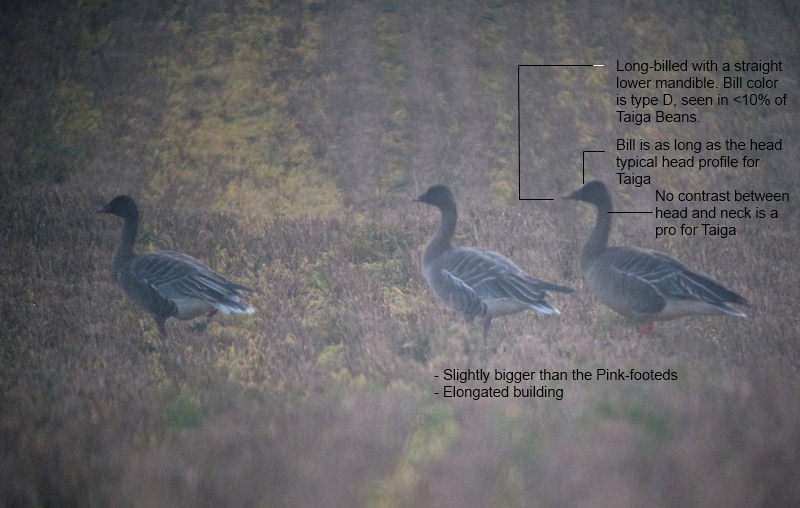
Last  November, James Lidster sent me this picture of an individual in the UK. So, what groupwise approach? Well, let's see if we can note something:


This must be a Taiga Bean, since Tundra never shows a bill lenght that is the same as the head. The structure and size is also better for Taiga, probably a female.

Here is the figure of Burgers et al (1991) wherein you can see the variability of the bill patterns.

February 2011, The Netherlands: compare the bills and head profile. The bill type is between B and C.

Next week, some more pics of some families...